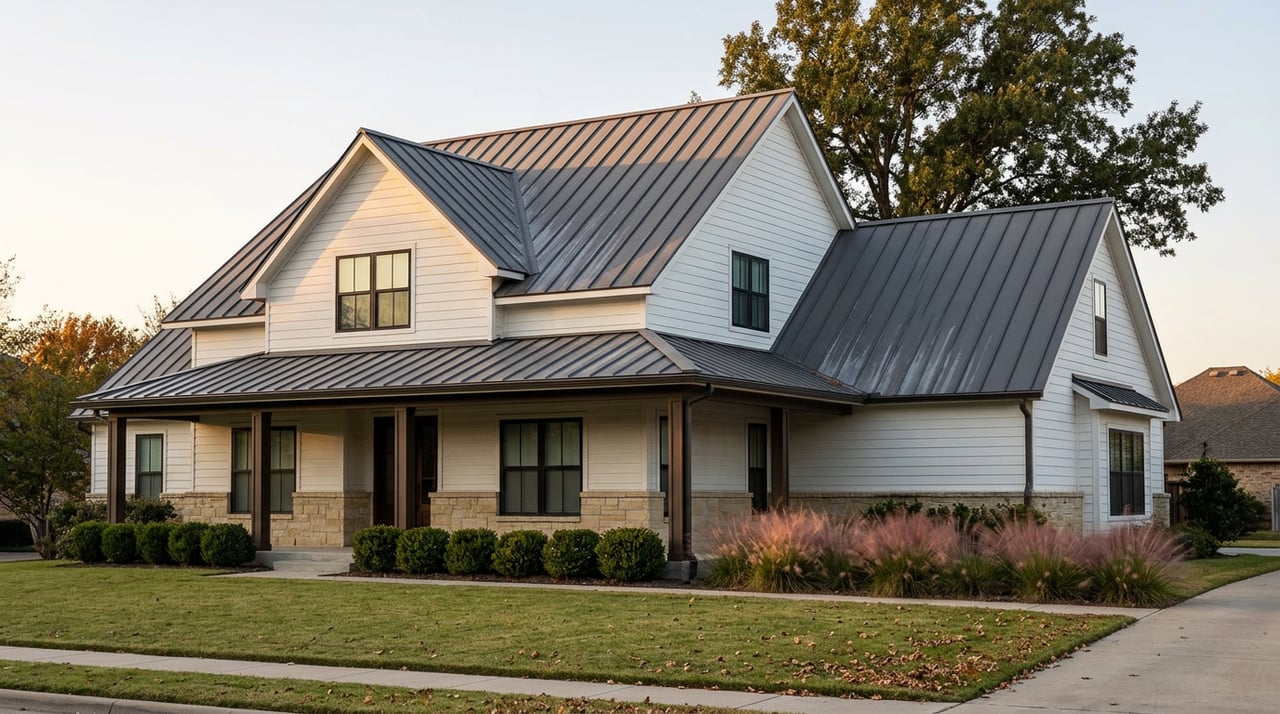
"Strengthening homes is one of the most effective ways to reduce damage and control insurance costs," Oklahoma Insurance Commissioner Glen Mulready said when the state opened its home-fortification grant to every county in January 2026.
Every conversation about storm resilience in Moore starts underground. A buyer walks through a house built anywhere near the May 2013 tornado path and the first question out of their mouth is almost always about the shelter. Is there one. Is it in the garage or the yard. Does it lock from the inside. It is a reasonable question in a city that watched an EF-5 tornado tear through its own neighborhoods, and it shapes how nearly every Moore listing gets shown and sold.
But the shelter is not the part of the house that shows up on a disclosure form as its own line item, and it is not the part that moves a buyer's insurance quote in a predictable, quantifiable way. The roof is. And in 2026, Oklahoma built an entire state program around that fact, one most Moore sellers have not connected to their own listing yet.
What the Disclosure Form Actually Asks
Oklahoma's Residential Property Condition Disclosure Statement, required under the Residential Property Condition Disclosure Act (Title 60 O.S. §831 et seq.), does not contain a dedicated question asking a seller whether the home has a storm shelter. The current 2026 version of the form groups it inside a broader structural question, asking whether the seller is aware of any defect or condition affecting the walls, roof structure, foundation, or the "basement/storm cellar," among other components. A shelter only enters the disclosure conversation if something is wrong with it. Its mere existence, its permit status, and whether it was ever inspected are not things the form makes a seller affirmatively state.
That gap matters in a city where a lot of shelters went into the ground fast in the years after 2013. The City of Moore requires a Storm Shelter Building Permit Application separate from a standard building permit, and a city inspector has to verify the anchoring system on an above-ground unit or the depth and ballast on an underground one before the area gets backfilled. A shelter installed correctly but never permitted does not fail on safety grounds. It fails on paperwork, and that paperwork gap tends to surface exactly when a title company or a buyer's agent starts pulling permit history during a sale, not before.
If you're selling a home in Moore with a shelter already in place, the disclosure form will not force the issue. A call to the city's Inspections Department at 405-793-5051, or a check through the city's online permitting portal, will tell you whether the shelter is on record. That is worth knowing before a buyer's agent finds the gap for you.
The Number That Actually Shows Up on an Insurance Quote
While the shelter conversation stayed informal, the roof got a formal program. The Oklahoma Insurance Department's Strengthen Oklahoma Homes initiative went statewide across all 77 counties in January 2026, offering eligible homeowners up to $10,000 toward upgrading a roof to the Insurance Institute for Business and Home Safety's FORTIFIED Home standard. The department opened its most recent application round on July 13, 2026, awarding grants first-come, first-served as funding allows, with a homestead exemption on file as one of the qualifying requirements.
The state's own numbers make the case plainly. A FORTIFIED roof can reduce severe storm damage by up to 80 percent, and the Insurance Department reports that certified homes see wind and hail premiums drop by 20 to 30 percent. Pilot participants averaged about $750 a year in insurance savings, which works out to roughly $7,500 over a decade. By the program's July 2026 update, the state had certified more than 400 homes and put more than $4 million into these upgrades since the pilot phases began.
Here is the contrast that matters for anyone pricing a Moore listing right now:
| Storm Shelter | FORTIFIED Roof | |
|---|---|---|
| Disclosure requirement | Not a separate line item; only surfaces if defective | Not a disclosure item either, but verifiable through certification records |
| Permit trail | Separate city permit required; often skipped in older installs | Documented through the FORTIFIED evaluation and IBHS certificate |
| State financial help | SoonerSafe lottery, capped at $3,000, not guaranteed | Direct grant up to $10,000, first-come basis |
| Reported insurance effect | Varies by carrier, no set figure | 20 to 30 percent reduction reported by the state |
The shelter buys peace of mind and, for many buyers in Moore, it is genuinely part of why they choose one house over another. As of late August 2026, roughly 76 homes on the Moore market were listed with a storm shelter as a named feature, at a median list price around $255,000, concentrated in areas like Westmoor, The Apples, Regency Park, and Lake Woods. That is real buyer demand. But demand is not the same as a documented financial return, and a shelter alone does not come with a state-reported discount range the way a FORTIFIED roof does.
The state's own SoonerSafe rebate program, which helps offset the cost of a new shelter, tops out at $3,000 and runs as an annual lottery rather than a guaranteed benefit. Registration periods have opened at different points from year to year, sometimes with priority given to counties tied to a recent disaster declaration, so anyone counting on it as part of a renovation budget should check the current status directly at soonersafe.ok.gov rather than assume last year's timeline still applies.
"A safe, resilient home is one of the best protections a homeowner can have against Oklahoma's severe weather," said Deputy Commissioner Ashley Scott, who directs the Insurance Department's OKReady initiative, when the program expanded eligibility ahead of the 2026 statewide rollout.
What This Means If You're Listing or Buying in Moore Right Now
If you're getting ready to sell, the more useful pre-listing call this year might not be to a shelter installer. It might be to a certified FORTIFIED evaluator, to see whether your existing roof is close to qualifying or whether the grant could fund enough of the upgrade to make certification worth pursuing before you list. A roof with a FORTIFIED certificate gives a buyer's agent something concrete to hand to an insurance agent on day one, in a way a shelter with no paper trail cannot.
If you already have a shelter and you're not sure it was permitted, find out now rather than during option period. Sellers who confirm and document their permit history ahead of time avoid the awkward conversation where a buyer's inspector flags an unregistered structure that has otherwise worked fine for a decade.
And if you're buying, ask for the shelter's permit number the same way you'd ask for a roof's age. A working shelter with no permit is not a dealbreaker, but it is a repair-adjacent conversation worth having before closing rather than after.
None of this means the shelter conversation stops mattering in Moore. It means the paperwork and the money follow a different feature than the one everyone leads with.
Whether you're weighing a FORTIFIED evaluation before listing or trying to figure out what an unpermitted shelter means for your closing timeline, AIM Real Estate has spent years working through exactly this kind of property-condition detail alongside Oklahoma City metro buyers and sellers. Contact Us and we'll walk through what your specific situation actually needs before it becomes a surprise at the closing table.